Priority dispatch
Agreement customers go to the front of the queue ahead of non-contract calls. In August, that is the whole ballgame.
 Mechanical
Services
Mechanical
Services
Emergency calls are the most expensive way to run a building. A documented PM program finds the failure before your tenants do — and gives you a paper trail you can take to ownership.
A commercial cooling season in Central Texas runs roughly March through October, and equipment here accumulates run hours far faster than the maintenance intervals in the manufacturer literature assume. Filters load up, coils foul, belts stretch, contactors pit and refrigerant charge drifts — all on a predictable schedule.
Handled on a schedule, those are inexpensive, planned, business-hours items. Handled reactively, the same problems become emergency calls at overtime rates, usually on the hottest day of the year, usually with a tenant already complaining. The cost difference is not close.
The second benefit matters just as much for facility managers: documentation. A maintenance program produces a written record of every piece of equipment in your building, its condition, and what it will need and when. That is what turns a capital request into a defensible one.
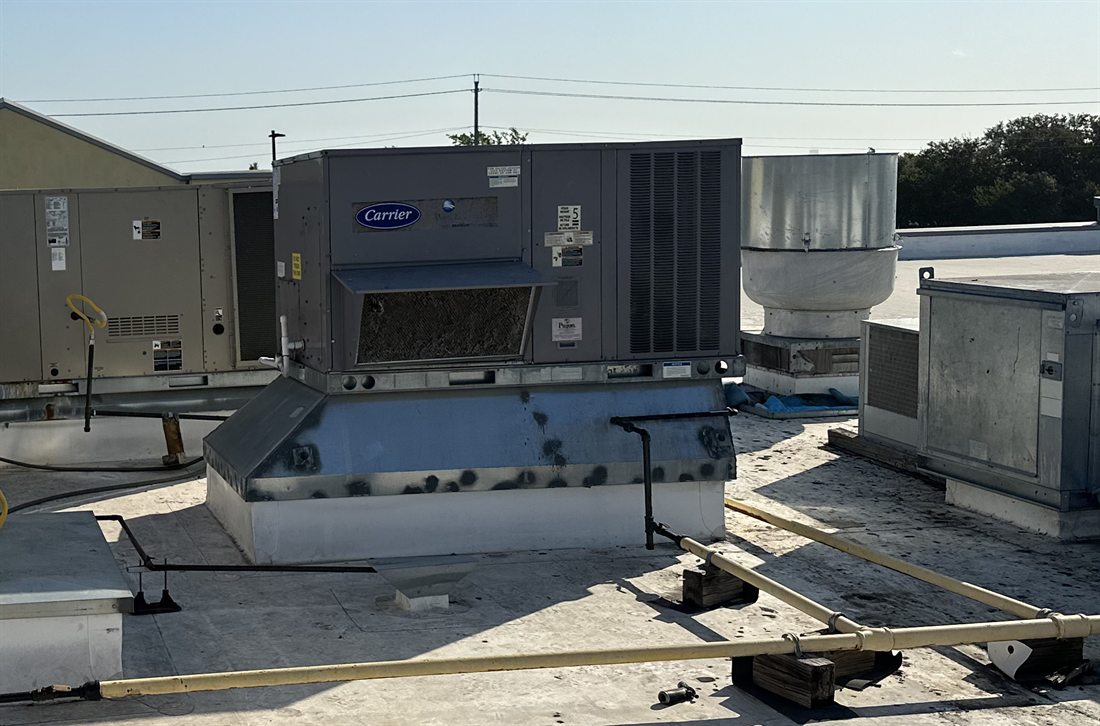
We walk the building and document every unit — make, model, serial, tonnage, age, location and current condition. Many buildings have never had this done, and it is useful the day it exists.
Typically quarterly or semi-annual depending on equipment type, criticality and run hours. Visits are scheduled in advance so your tenants and your calendar are not surprised.
Filters and belts, coil cleaning, condensate treatment, refrigerant and amp draw readings, electrical connections, control verification and safety checks — recorded, not just performed.
After every visit: photos, the actual readings, and a prioritized list of what needs attention now, what needs budgeting for, and what can wait.
Agreement customers go to the front of the queue ahead of non-contract calls. In August, that is the whole ballgame.
Reduced rates on any repair work outside the scope of the agreement, including after-hours calls.
We already have your inventory, your history and your access notes, so diagnosis starts ahead rather than from zero.
A rolling view of what is aging out and roughly what it will cost, so capital requests are planned rather than emergency.
Most catastrophic failures announce themselves months in advance in the readings. PM is how you hear them.
Maintained rooftop units in this climate routinely outlast neglected ones by several years. That is deferred capital spend.
Maintenance agreements for property managers, facility directors and building owners across the Austin metro and Central Texas.
It scales with the equipment count, equipment type and visit frequency, so a small retail building with four rooftop units and a facility with a central plant are very different numbers. We price it after walking the building and building the equipment inventory — we are not going to quote a maintenance program off a phone call, because the resulting number would be wrong in one direction or the other.
Quarterly for most commercial buildings in this climate, semi-annual at minimum. Our cooling season is long enough that a once-a-year visit leaves equipment unattended through the hardest months. Critical equipment — chillers, data room cooling, healthcare applications — usually warrants a tighter schedule and more logged data.
Then the useful question is whether you are getting written condition reports with actual readings after every visit. A great many maintenance contracts in this market amount to a filter change and an invoice. If you cannot pull up what your equipment looked like last quarter and what it needs next year, you are paying for maintenance and not receiving the part of it that has the most value.
Tell us what is going on and we will get a technician or an estimator on it. For anything urgent, call — that is always the fastest path.
Emergency commercial HVAC and chiller response across Austin and Central Texas — nights, weekends and holidays.